China has become a major sourcing base for Wpc Exterior Panel products, serving residential, commercial, and landscape projects worldwide. Manufacturers now offer embossed surfaces, co-extruded skins, concealed fastening systems, and wood-like colors. These details matter when a façade faces rain, ultraviolet exposure, salt air, or repeated temperature changes.
Dr. Amar K. Mohanty, a leading biocomposites researcher, has stated, “The future is not about replacing one material with another; it is about designing better material systems.” This principle fits Wpc Exterior Panel selection. A responsible supplier should explain the material formula, recycled content, surface treatment, density, fire performance, and installation limits. Product samples can reveal more than polished catalog images. Check the edge finish, color consistency, screw holding, and surface stability after moisture exposure.
Small details matter.
The strongest Chinese manufacturers combine controlled extrusion, dependable quality inspection, and practical export experience. They should provide test reports, production photographs, installation guidance, and clear warranty terms. However, no panel is perfect. A thick profile may improve rigidity but increase shipping costs. A darker finish can create greater heat absorption. A low price may also reflect thinner walls or weaker protective layers.
This guide introduces leading China Wpc Exterior Panel manufacturers and suppliers through a practical purchasing lens. It considers product quality, customization, certifications, capacity, delivery reliability, and communication. Buyers should still verify current documentation and test samples independently. Supplier claims deserve evidence. That step is sometimes missed.
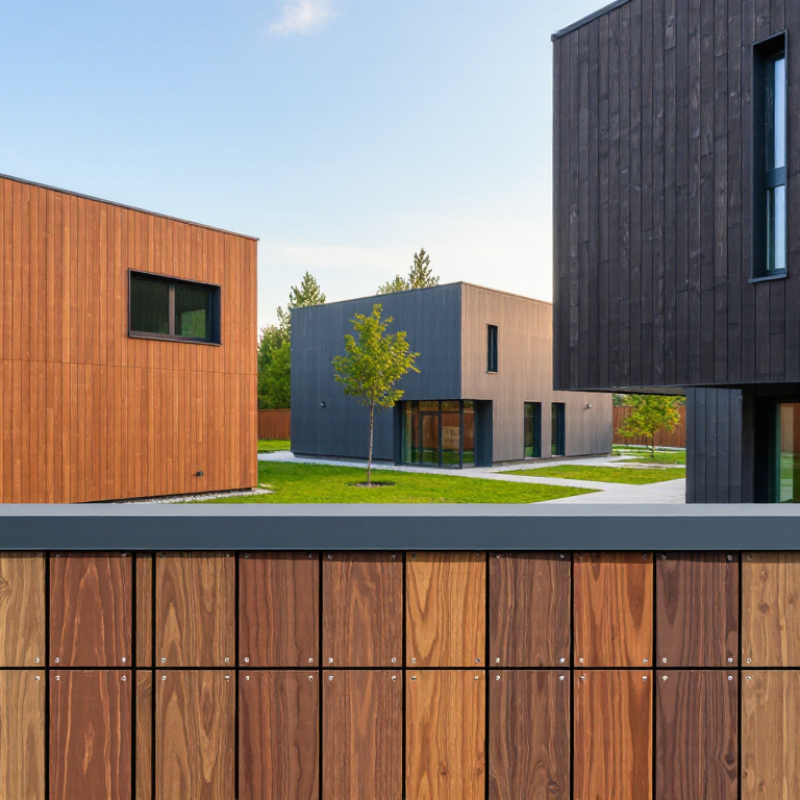
WPC exterior panels combine wood fibers with thermoplastic polymers and performance additives. The wood component provides texture and stiffness. The polymer helps resist moisture, insects, and repeated weather exposure. During production, heat and pressure blend these materials into a stable profile. After cooling, the surface may receive embossing, brushing, or a protective coating. They are not solid timber. This distinction matters.
On a building, WPC panels usually work as a ventilated rainscreen. A small cavity behind the panels allows air movement and helps drain incidental water. Hidden clips or visible fasteners secure the boards to a supporting frame. Installation gaps absorb thermal expansion and contraction. Without these gaps, joints may buckle during hot weather. Darker colors often absorb more heat and need greater movement allowance. The panel blocks direct rain, but it does not replace proper flashing, membranes, or drainage.
Experienced installers inspect wall alignment before fixing any panel. They also check corners, window openings, and the lowest drainage point. A poorly sealed penetration can cause more damage than a slightly scratched surface. No exterior product is maintenance-free. Dust, algae, and airborne pollution still collect on exposed faces. Gentle cleaning usually preserves the finish better than aggressive abrasion. Technical data should be reviewed for fire performance, fastener spacing, wind loads, and local climate conditions. Some specifications look precise, yet site conditions vary. That gap deserves honest attention.
| Data Dimension | Typical WPC Exterior Panel Data | What It Means for Buyers and Suppliers |
|---|---|---|
| Material Definition | A composite made from thermoplastic resin, wood flour or fiber, and performance additives. | The formulation affects strength, moisture resistance, color stability, weight, processing behavior, and cost. |
| Common Polymer Types | Polyethylene, polypropylene, or polyvinyl chloride are commonly used thermoplastics. | Polymer selection influences temperature resistance, rigidity, recyclability, and compatibility with outdoor applications. |
| Typical Panel Thickness | Approximately 8–25 mm for many decorative, cladding, and screening applications. | The required thickness depends on span, wind load, fixing method, panel profile, and local building requirements. |
| Typical Panel Width | Common production widths range from about 100 mm to 300 mm for slatted or siding-style profiles; larger sheet formats are also available. | Width affects visual layout, joint quantity, handling, and installation speed. |
| Panel Length | Often supplied in fixed lengths commonly between 2.4 m and 5.8 m, subject to tooling and transport limits. | Longer panels can reduce joints but may increase shipping, handling, and thermal-movement considerations. |
| Panel Structure | Solid, hollow, co-extruded, capped, or profile-based construction. | Hollow profiles reduce weight, while capped surfaces can improve resistance to staining, moisture, and weathering. |
| Density | Frequently falls within approximately 0.9–1.4 g/cm³, depending on resin, wood content, fillers, and profile design. | Density influences panel weight, screw-holding behavior, rigidity, and transportation cost. |
| Wood-Fiber Content | Many formulations use roughly 30–70% wood flour or fiber by weight, although actual ratios vary. | Higher wood content can improve natural appearance and stiffness but may increase moisture sensitivity if the formulation is not well protected. |
| Manufacturing Process | Compounding, pelletizing or direct mixing, profile extrusion, cooling, cutting, surface finishing, and quality inspection. | Consistent mixing and extrusion control are important for dimensional accuracy, surface quality, and batch consistency. |
| Working Principle | The polymer binds the wood component into a moisture-resistant composite while additives support color retention, processing, and durability. | WPC panels combine some visual characteristics of wood with thermoplastic processing and reduced routine maintenance. |
| Moisture Performance | Generally more moisture-resistant than untreated wood, but not completely waterproof or immune to water absorption. | Edges, cut ends, fastener holes, joints, and drainage details still require proper protection and installation. |
| Dimensional Movement | Thermal expansion and contraction are normal; the exact movement varies by formulation, profile, length, temperature, and installation method. | Expansion gaps, suitable clips, and correctly spaced supports are essential for outdoor installation. |
| UV and Color Stability | Outdoor exposure can cause gradual fading or surface weathering; UV stabilizers, pigments, and capped layers can reduce the effect. | Ask for weathering-test results and acceptable color-change criteria rather than relying only on a color sample. |
| Maintenance Requirement | Routine cleaning with water and a mild detergent is commonly sufficient; repainting is usually not required. | Maintenance depends on exposure, surface texture, drainage, pollution, biological growth, and product instructions. |
| Machining and Installation | Many WPC profiles can be cut, drilled, and fastened with standard woodworking tools fitted with suitable blades and bits. | Installation must follow the product’s fixing schedule, ventilation requirements, support spacing, and expansion guidance. |
| Fire Performance | WPC is combustible to varying degrees; fire behavior depends on resin, additives, profile, and tested assembly. | Request an applicable fire classification or test report for the intended building application and jurisdiction. |
| Typical Exterior Uses | Facade cladding, privacy screens, balcony decoration, garden walls, soffits, outdoor partitions, and architectural feature panels. | Suitability depends on structural design, local code, weather exposure, fire requirements, and the product’s tested end use. |
| Quality-Control Checks | Dimensions, weight per meter, color consistency, surface defects, moisture behavior, mechanical properties, and packaging condition. | A supplier should provide a technical datasheet, inspection records, installation instructions, and samples from the intended production batch. |
| Sustainability Considerations | Some products incorporate recycled polymers or reclaimed wood fiber, but recyclability and environmental performance vary by formulation and additives. | Verify recycled-content claims, responsible sourcing documentation, service life, disposal options, and relevant environmental declarations where required. |
Note: The numerical ranges shown are typical industry reference values, not universal specifications. Final performance should be confirmed through the supplier’s technical datasheet and project-specific testing.
They combine wood fiber or flour with thermoplastic polymers and performance additives. Pigments and stabilizers improve consistency and appearance. Some panels include a protective cap layer.
Common uses include façades, balcony screens, garden walls, soffits, and sheltered outdoor ceilings. Match the panel to sunlight, rainfall, wind, and cleaning conditions. A shaded balcony is not a coastal wall.
No panel is completely maintenance-free. Low water absorption can reduce swelling, rot, and insect damage. Strong sunlight may still cause fading. That limitation matters.
Request composition data, water absorption results, UV aging reports, fire-performance documents, and dimensional data. Confirm test methods, laboratory scope, and report dates. Attractive samples are not enough.
Request factory registration details, production capacity, and a clear contact person. Check whether extrusion, embossing, and cutting occur in-house. An on-site audit is stronger than a video. Clean records matter.
Order samples from different production batches. Measure thickness, color variation, texture, and joint accuracy. Try cutting, drilling, and fastening. Expose sections to moisture and temperature changes. This is only a rough check.
Follow specified fastener spacing and allow for thermal movement. Leave ventilation behind the cladding. Use compatible trims around windows and doors. Small gaps can create bigger problems.
Confirm minimum order quantity, lead time, packaging, spare panels, inspection procedures, and batch traceability. Review warranty exclusions for extreme climates or incorrect installation. The cheapest quotation may become expensive later. I would keep a written risk list.
A Wpc Exterior Panel is a composite building product made from wood fibers or flour, thermoplastic polymers, and carefully selected additives. It is designed to combine the natural appearance of wood with improved resistance to moisture, insects, decay, fading, and everyday wear. Depending on the formulation and surface treatment, these panels can provide stable dimensions, low maintenance, and reliable outdoor performance for walls, façades, balconies, fences, and decorative structures.
In China, WPC exterior panels are commonly produced through material mixing, extrusion, cooling, cutting, surface finishing, and quality inspection. When evaluating manufacturers and suppliers, buyers should review raw material consistency, production technology, weathering performance, dimensional accuracy, fire and safety documentation, testing records, customization capability, and delivery reliability. Purchasing decisions should also consider panel size, color, texture, installation method, warranty terms, packaging, and after-sales support. Clear quality standards and complete technical information help ensure that the selected panels are suitable for the intended climate, building design, and long-term application.

 Rongsen