Choosing an Embossed Pvc Sheet is more technical than matching a color to a sample board. Texture, thickness, chemical resistance, fire behavior, and installation conditions all affect performance. A deep wood-grain pattern may look convincing under showroom lighting, yet collect dust in a commercial washroom. A thinner sheet may also reduce cost, but it can telegraph uneven walls or deform near heat sources.
Industry data supports careful specification. Grand View Research’s Polyvinyl Chloride Market Size, Share & Trends Analysis Report identifies construction as a leading PVC application, driven by durability, moisture resistance, and processing flexibility. PlasticsEurope’s Plastics—the Fast Facts 2024 also places PVC among Europe’s significant material families. These reports describe market direction, not a guarantee for one project. That distinction matters.
Professional selection should connect the sheet to measurable conditions. Review thickness tolerance, surface hardness, slip requirements, and expected cleaning chemicals. Ask suppliers for technical data sheets, safety information, colorfastness results, and batch consistency records. ASTM D543 can help assess chemical resistance, while ASTM D638 provides tensile-property testing guidance. Fire requirements should follow the applicable local standard, such as EN 13501-1 or ASTM E84, where relevant.
Experience still exposes gaps. A sample can pass inspection but fail after repeated impacts, poor adhesive coverage, or strong sunlight. Test a small installed area first. Check joints at eye level. Touch the embossed surface after cleaning. A perfect catalogue image is not evidence of long-term performance. The best choice balances appearance, service conditions, compliance, maintenance, and honest uncertainty.
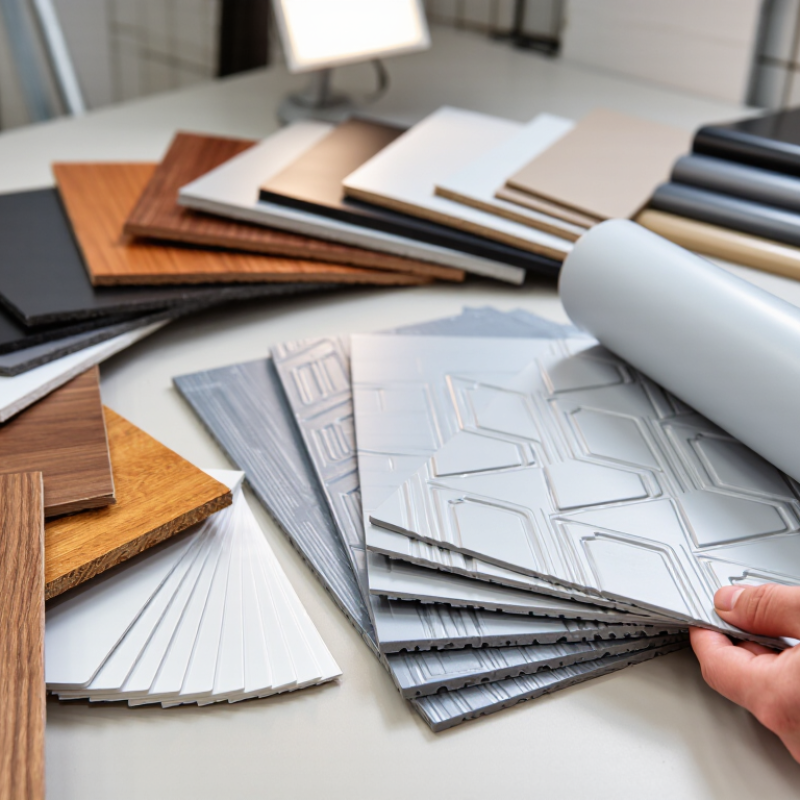
Choosing embossed PVC sheet starts with the work it must perform, not its surface pattern. Describe the expected load clearly: steady pressure, repeated flexing, impact, or personal contact. A decorative panel may need only light support. A protective cover may face abrasion and bending. Record the load, support spacing, and exposure time before requesting samples. These details often show that a thinner sheet is unsuitable, even when it looks strong.
Temperature deserves equal attention. Measure the lowest and highest temperatures at the sheet, not just the room temperature. Include heat from lamps, machinery, sunlight, cleaning water, and nearby metal surfaces. PVC can soften, shrink, or become less flexible outside its rated range. Ask for technical data covering the actual temperature cycle. Then test a sample under load at both extremes. A sheet that performs well on a workbench may behave differently outdoors. That assumption is easy to miss.
Tips: Keep thickness within 0.5–3 mm, but select it according to function. Use 0.5–1 mm for light lining or visual panels. Consider 1.5–3 mm for greater stiffness, impact resistance, or wider spans. Embossing can affect cleaning and forming. Check the backing, bend radius, and fixing method together. When evidence is limited, build a small prototype, measure it, and revise the specification. The first choice may not be right.
Choosing an embossed PVC sheet starts with the working surface, not the catalog photograph. Pattern depth changes both appearance and cleaning effort. Shallow embossing gives a calmer finish and traps less dust. Deep embossing creates stronger visual texture and can hide minor scratches. It may also hold grit in busy areas. Measure the texture under angled light. This reveals uneven peaks.
Slip rating deserves careful attention when moisture, oil, or frequent footwear contact is expected. Ask for test results, test methods, and wet or dry conditions. A high rating is useful only when it matches the installation environment. A deeply textured surface may improve grip, but it can feel uncomfortable under carts or bare feet. Check sample tiles with wet shoes and a loaded trolley. Small tests matter. Do not rely on touch alone.
Surface wear resistance should be judged through abrasion data and real traffic forecasts. Compare expected footfall with the supplier’s test classification and protective finish. Look for edge rounding, gloss loss, and exposed color after repeated rubbing. In one project, a darker pattern looked durable but showed dust and scuff marks quickly. That was an easy assumption, and not a good one. Request production samples, review technical documents, and inspect the sheet after cleaning cycles. Actual use rarely matches the specification perfectly.
Compare embossed patterns by depth, slip rating, and surface wear resistance
Deeper embossing generally improves texture and wet-foot traction, while heavier embossing can be more difficult to clean. The reference values use common specification-style ranges: embossing depth is shown in millimetres, slip performance is represented by the R rating scale, and wear resistance is shown as abrasion cycles. Always confirm the supplier’s test method and project requirements before selection.
Choosing embossed PVC sheet starts with the texture, but performance data should decide the final grade. ASTM D638 tensile testing measures strength, yield behavior, and elongation using controlled specimens. Ask for specimen direction, thickness, conditioning, and break location. A reported tensile strength of 45 MPa means little without those details. Embossing changes thickness locally. The sheet can look robust, yet tear at a sharp valley.
ASTM D2240 Shore hardness data complements tensile results. A Shore D value near 80 may indicate a firm surface, but it does not predict impact resistance or long-term flexibility. Request test temperature, dwell time, scale, and five-point average. According to Plastics—The Facts 2024, PVC represented about 10% of European plastics demand. High demand is not proof of quality. That distinction matters.
For panels exposed to carts, cleaning, or repeated bending, compare reports with actual use conditions. Check tensile strength, elongation at break, and Shore D hardness after aging. ASTM results from a smooth control sample may overstate embossed sheet performance. I would also inspect a cut edge under angled light and flex a 300 mm sample by hand. Useful? Yes, but not a laboratory test. Some suppliers omit batch variation; that omission deserves a question. Require traceable reports, calibrated equipment, and data from at least three production lots.
| PVC Sheet Type | Typical Thickness (mm) |
Density (g/cm³) |
Tensile Strength ASTM D638 (MPa) |
Elongation at Break ASTM D638 (%) |
Hardness ASTM D2240 |
Embossing Depth (mm) |
Recommended Project Use |
|---|---|---|---|---|---|---|---|
| Rigid Embossed PVC | 1.0–3.0 | 1.35–1.45 | 45–55 | 20–50 | Shore D 75–85 | 0.15–0.60 | Wall protection, interior panels, equipment covers, and architectural cladding |
| Semi-Rigid Embossed PVC | 0.8–2.0 | 1.25–1.40 | 30–45 | 80–180 | Shore D 65–75 | 0.10–0.50 | Decorative panels, packaging liners, partitions, and formed interior components |
| Flexible Embossed PVC | 0.5–2.0 | 1.15–1.35 | 12–25 | 150–350 | Shore A 75–90 | 0.10–0.40 | Flexible covers, upholstery surfaces, curtains, gaskets, and protective liners |
| Foamed PVC Embossed Sheet | 2.0–10.0 | 0.45–0.75 | 8–20 | 10–40 | Shore D 45–65 | 0.20–1.00 | Sign panels, display boards, lightweight partitions, and interior decoration |
| Selection guidance: Choose rigid or semi-rigid PVC when dimensional stability and surface wear resistance are priorities. Choose flexible PVC when bending performance and impact absorption are more important. Foamed PVC reduces weight but generally provides lower tensile strength and hardness. ASTM D2240 hardness values must be compared on the same scale; Shore A and Shore D results are not directly interchangeable. | |||||||
| Data note: The values shown are representative engineering ranges for commonly formulated PVC sheet grades, not product specifications. Actual results vary with plasticizer content, fillers, stabilizers, foaming level, embossing pattern, specimen thickness, and conditioning. Confirm the selected sheet using a current test report measured according to ASTM D638 and ASTM D2240. | |||||||
Fire performance should match the installation site, not only the product brochure. NFPA reported approximately 1.39 million fires in the United States during 2023, with billions of dollars in direct property damage. For wall panels near kitchens, workshops, or electrical equipment, request tested results under ASTM E84 or EN 13501-1. These standards measure different properties, so their ratings are not interchangeable. Ask for the complete test report, including thickness, embossing pattern, substrate, and mounting method. Small details matter.
Chemical exposure is equally practical. A sheet used beside cleaning chemicals, oils, or laboratory fluids needs verified resistance data. Review immersion or spot-test results from recognized methods, such as ASTM D543. Check concentration, temperature, exposure time, and surface changes. PVC may tolerate many diluted acids, but solvents can soften or stain it. I would not trust a general “chemical resistant” claim. Test an offcut first. It takes minutes.
UV stability depends on location and maintenance. ASTM G154 can compare accelerated weathering performance, but exposure hours do not directly equal outdoor service years. The 2023 Global Solar Atlas data shows that solar intensity varies sharply by region, roof angle, and season. Inspect southern or unshaded installations more carefully. Look for color-change, gloss-retention, and tensile-strength data after UV exposure. A perfect laboratory result may still disappoint when dirt, heat, and standing water combine. That limitation deserves attention.
Supplier selection should begin with tolerance control, not surface appearance. Ask for thickness results from at least five points across each sheet. For a 2.00 mm specification, a practical purchasing target may be ±0.10 mm, but the acceptable range depends on cutting, thermoforming, and installation. Request embossing-depth measurements too. A smooth-looking sample can hide inconsistent peaks. I have seen sheets fit well at the center but bind at the edges. That is not a minor defect.
MOQ affects both cost and quality validation. Choose a supplier willing to provide trial quantities before accepting a full production order. Confirm whether MOQ applies per color, texture, thickness, or total shipment.
Certifications should match the application. ISO 9001 supports process control, while REACH and RoHS documentation helps verify chemical compliance. For construction or electrical uses, request the relevant fire or performance certification, not a generic certificate. Check the certificate number, testing scope, and validity.
Service-life claims need test evidence. ASTM G154 and ISO 4892-3 define accelerated weathering methods, but 1,000 test hours do not automatically equal ten outdoor years. Ask for color-change data, gloss retention, tensile results, and test conditions. ISO 4589 oxygen-index data can also help assess combustion behavior, where applicable. Be cautious with perfect forecasts. Real service life changes with sunlight, cleaning chemicals, temperature, and installation stress. A supplier that explains limitations may be more reliable than one promising an exact lifespan.
Shallow patterns look calmer and trap less dust. Deep patterns create stronger texture and hide small scratches. They may hold grit.
View the sheet under angled light. Uneven peaks become easier to see. Measure depth at several points, not one location.
Ask for test results, methods, and wet or dry conditions. Test sample tiles with wet shoes and a loaded trolley. Touch alone is insufficient.
Yes. Deep texture may improve grip but feel uncomfortable under carts or bare feet. Cleaning can also require more effort.
Compare abrasion data with expected foot traffic. Inspect gloss loss, rounded edges, and exposed color after repeated rubbing. Dark surfaces may show dust quickly.
Request complete test reports for the installation environment. Include thickness, pattern, substrate, and mounting method. Different standards are not interchangeable.
Review concentration, temperature, and exposure time in the test data. Test an offcut with the actual cleaner. General claims are not enough.
Ask for color-change, gloss-retention, and tensile-strength results. Sunlight varies by region and roof angle. Laboratory hours do not equal service years.
Request thickness measurements from at least five points per sheet. Check embossing depth too. A smooth sample can hide inconsistent peaks.
Be careful. Cleaning chemicals, heat, sunlight, and installation stress change real performance. I might still overestimate laboratory results. That deserves review.
Choosing the right Embossed Pvc Sheet begins with clearly defining the project’s operating conditions. Consider expected loads, the installation temperature range, and the required sheet thickness, typically between 0.5 and 3 mm. Embossed patterns should then be compared according to embossing depth, slip rating, ease of cleaning, and resistance to surface wear. These factors help ensure that the sheet provides both practical performance and a suitable appearance for its intended environment.
Before making a purchase, review technical test data, including ASTM D638 tensile strength results and ASTM D2240 hardness values. The installation site should also determine the required levels of fire safety, chemical resistance, and UV stability. Finally, evaluate suppliers based on thickness and pattern tolerance control, minimum order quantity, relevant certifications, technical support, and documented service-life data. A careful comparison of these details can help you select a durable, safe, and cost-effective material that meets the project’s long-term requirements.

Rongsen